
Step 2 · Plan with your points
I Purchased Marriott Vacation Club Points—Now What Do I Do?
Start here
Start with the owner website
If you are not familiar with the Marriott Vacation Club owner website, spend time browsing it. Explore the planning tools in the Use Points menu, including Points Charts, When Can I Reserve?, Points Calculators, and Owner Benefit Levels.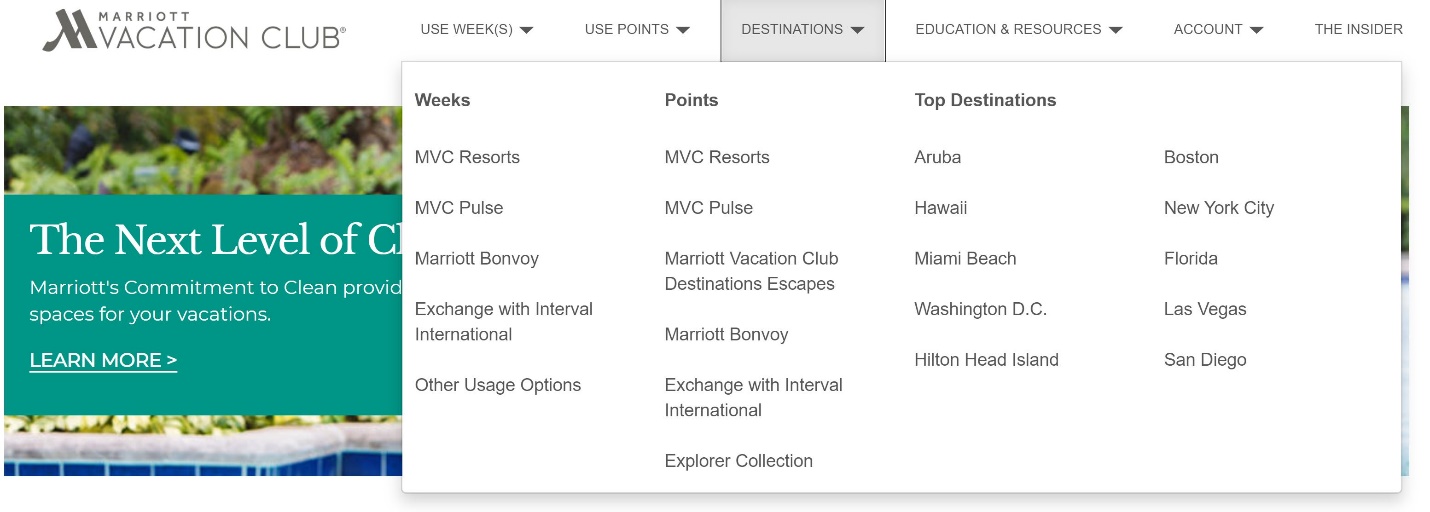
Under Destinations, choose the resorts you are interested in to learn more.
Where do you want to go?
There is a wide range of resorts to consider, including Marriott, Westin, Sheraton, and Ritz-Carlton properties Think about the kind of trip you want: a romantic getaway, a family vacation, a place you have always wanted to see, or a return to a favorite spot.Will you drive or fly? Travel domestically or internationally? Each choice changes the way you plan. Search by activity—beach, family, golf, and more—or by country, state, or city. As you browse, check the villa sizes carefully. Some city properties only have guest rooms, which may not work for a group of more than four.How many points?
Be realistic about what your points can do. A 2,000-point owner will probably not be able to reserve Park City, Utah during Christmas. Having said that, by being flexible, you can dramatically stretch your point potential.When can you go?
Timing matters just as much as location. Traveling during a lower-demand period can mean more trips; traveling at Christmas may be worth using more points. Neither is better—both take planning.Make it yours
Maxing Marriott is not here to teach a basic reservation. We are here to help you make a reservation that maximizes your opportunities and stretches your points as far as possible.Your planning strategy
Plan early—REALLY early
For Marriott Vacation Club, “early” is not six months out. Start planning your major trip for the upcoming use year more than a year ahead—preferably up to 18 months before you want to check in. Begin with the trip that matters most: decide where you want to go and the villa size you need. Those decisions are usually less flexible than the date, and that major trip may use most of your points—or, for a high-priority trip, may be worth borrowing points from the following year.
1 Reserve the major trip first
Choose the destination and villa size your family truly wants before the best inventory disappears. The more important the trip, the earlier it belongs in your plan.2 Build with points left over
Use remaining points for additional vacations, prioritizing destinations in the order you want to visit them. A clear plan makes every point easier to place.3 Keep room for opportunity
I like to leave some points available for a getaway, a great airfare, or an Abound Escape that is genuinely a good deal. Points not used in a year may be banked for the next one, subject to current terms and deadlines.Meet Fancy Nancy
Fancy has 3,000 club points. She lives in California, loves the outdoors, and wants to bring her best friend to Tahoe in a future travel year. She needs a one-bedroom villa with a full kitchen and wants as many well-timed trips as possible without taking vacations too close together.
Look for shoulder seasons
Shoulder seasons are the periods just outside the highest-demand weeks. The 2027 Timber Lodge points chart below is a planning tool. It shows the kind of lower-point edges Fancy will focus on when the points chart for her actual travel year is available.As soon as that chart is published, Fancy will choose her dates and be ready to reserve 12–13 months in advance. For example, a Sunday check-in at the beginning or end of a lower-point segment can provide much of the weather benefit of a higher-demand period while using fewer points. Adding a weekend night or moving only one week can materially change the points required, so she will compare a few date ranges before she books.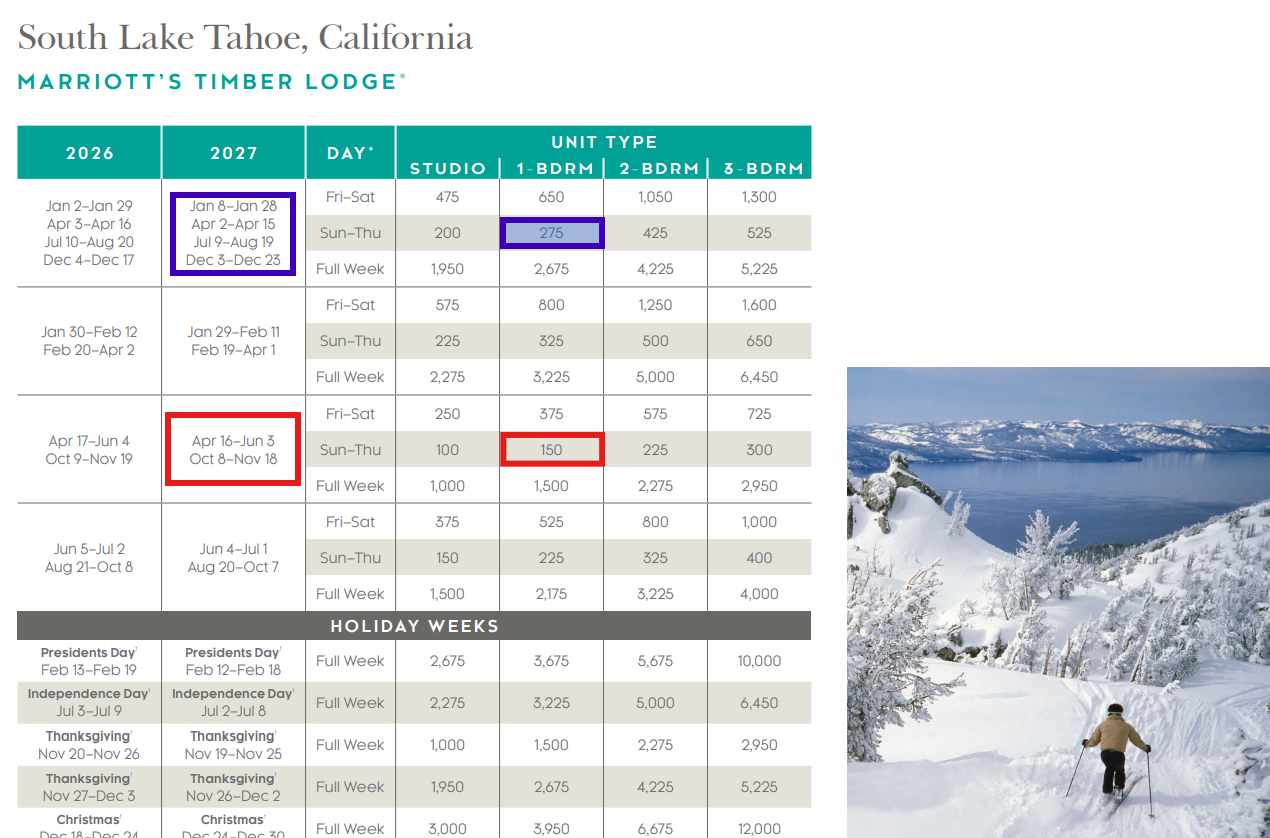
Use the resort’s current points chart to compare date ranges and nightly point values before choosing your stay.If Nancy checked in Sunday, May 30th, for 5 nights, it would only take 750 total points and still should be warm enough to get some great hiking in. If she went just one week later, she would have bumped up to a higher point segment and would need to use 1,125 points. There is not much difference in weather in one week, and it saves 375 points.

Marriott’s Timber Lodge. Photo courtesy of the resort.
Fancy’s future-year planning pattern
A planning pattern for three great trips
4 nights · 1 bedroom
Compare chart options
5 nights · 1 bedroom
Compare chart options
4 nights · 1 bedroom
Compare chart options
By being flexible, comparing current points charts, and reserving 12–13 months early, you can enjoy more nights without substantially increasing your vacation costs.

Photo courtesy of Lake Tahoe Tourism.
Photo courtesy of Lake Tahoe Tourism.
Examples are for planning illustration only. Current points charts, inventory, reservation windows, and program terms in the Marriott Vacation Club owner website control.
Recent Comments